
Find Hudson Residents by Record
Hudson is a town in Middlesex County, but resident-related records are not held by one county office. The town GIS and assessment database are the local address-to-parcel route. Middlesex South Registry in Cambridge keeps recorded land instruments. Hudson Town Clerk handles municipal records and local vital paths. Marlborough District Court is the identified district-court location, while Hudson Public Library and the Historical Society supply the historic layer.
Choose the source that matches the question. An address points first to a parcel. A deed or mortgage points to the registry. A person’s voter status has a separate state tool. A past household may appear only in dated reports, directories, newspapers, or yearbooks. Each result needs a source date, and none of these routes should be treated as a full resident profile.
- Use a Hudson address, owner name, or Map and Lot to locate the parcel in the town GIS.
- Search Middlesex South when the goal is a recorded deed, mortgage, plan, or party trail.
- Use the state voter lookup for its limited status purpose, with the required identifying inputs.
- Consult library or Historical Society holdings for a dated historical name and address lead.
- Send a narrow request to the record custodian when the material is not online or needs an official copy.
Four terms keep a Hudson search honest. They identify what a source can show, and they prevent a parcel or directory entry from being overstated.
- Roll
- A list or system kept for a specific public purpose, such as assessment or voter registration.
- Index
- A finding tool that points to a record, often by name, date, book, or document number.
- Criss-cross directory
- An address-arranged historical directory used to connect a street location with a listed name.
- Parcel
- A mapped unit of land used in local GIS and assessment work, not a proof of household membership.
Hudson Offices Behind Resident Records
Custody comes before search. The assessor and GIS team work with parcels and valuation information. The Registry records land instruments. Town Clerk holds municipal records and routes public-records requests. State election, court, and vital systems each have their own rules. For an address-by-address method, use the Hudson street directory rather than treating this office list as a street roster.
Hudson Parcel Records Search
The Town of Hudson’s assessment database is the town-linked property portal, while the GIS help guide supplies the clearer public workflow. GIS accepts Parcel ID, Street Address, and Owner. A selected result zooms to the parcel; clicking it opens parcel information, and More Info reaches assessment data. Hudson’s guidance identifies address, owner name, and Map and Lot as practical search keys.
| Hudson property search key | Use | Careful interpretation |
|---|---|---|
| Street Address | Locate a mapped property | It is not proof of who lives there |
| Owner | Find a public owner label | Owner and occupant can differ |
| Map and Lot | Carry a stable parcel reference across town records | It is not a legal description |
| Abutters | Return nearby parcels under a chosen map workflow | It is not a household census |
The live assessment portal did not expose its exact current form labels, result fields, or export controls in the research session. Do not assume a field exists until the portal shows it.
Hudson Voter Records and Precincts
Hudson has six precincts after the 2020 Census. A precinct is an election geography, not a neighborhood or household label. The state voter-status lookup takes a name, date of birth, and residential ZIP, and can return registration or pre-registration status, active or inactive status, polling place, and elected representatives. It is not a statewide resident directory.
Confidential voters are excluded from public lists and database results. A local request to Hudson Elections should seek only the lawful public fields and a defined list date or format. Do not treat a no-match as proof that a person is not a Hudson resident.
The state’s voter status lookup shows the official starting inputs.
The result supports one limited status check and needs a second source for identity or address context.
Current Hudson Resident Sources
Current directory-like sources have narrow coverage. Property systems refer to parcels and owners. Voter tools cover registration status under state rules. Registry indexes name parties to recorded instruments. Community organizations are not public member rosters. A Hudson resident lookup needs the record type and date to stay visible.
| Hudson source | What it records | Record keeper | Best access route |
|---|---|---|---|
| Assessment and GIS records | Public parcel and owner context | Hudson Assessors and GIS | Town portals |
| Voter status and local public fields | Registration information within legal limits | State and Hudson Elections | State lookup or local request |
| Recorded-land index | Parties to deeds, mortgages, plans, and related instruments | Middlesex South Registry | Public land-record portal |
| Municipal staff directory | Town staff contacts | Town of Hudson | Official staff directory |
| Community links | Organization contact leads | Town Community page | Official organization contact |
For a name-based confirmation sequence, use the Hudson resident lookup method and compare independent records rather than relying on a single hit.
Hudson Deed Records District
Hudson land records belong to the Middlesex South Registry district, not to a Hudson recorder office. The Registry index supports Recorded Land searches by Name, Document, Book, Property, Recorded Date, and an Unindexed Property Search for Books 1 through 1024. It also supports party, town, document-type, and date-range searching. A recorded instrument can link a party to a legal transaction, but it does not establish current residence.
Registry records and GIS serve different purposes. GIS locates a parcel and its municipal context. The registry keeps the recorded instrument trail, including deeds, mortgages, plans, discharges, easements, and related documents. Search the source that fits the claim, then inspect the image and its date rather than relying on an index line alone.
The Massachusetts registry locator confirms Hudson’s Middlesex South route.

This routing check prevents a Hudson search from being sent to the wrong land-record office.
Hudson Records Requests by Custodian
Massachusetts Public Records Law includes MGL c.66 §10, exemptions in MGL c.4 §7(26), and 950 CMR 32.00. Hudson’s guideline allows requests in person, by mail, fax, email, and other accepted written routes. A request should name the custodian, record type, date range, address, Map and Lot, case number, or other locating facts, and request an electronic format when useful.
Hudson’s primary Public Records Access Officer is Town Clerk Joan M. Wordell, with secondary RAO Jeff M. Malachowski. The town’s guideline uses a ten-business-day response framework. It may direct a requester to an existing online record and does not have to create a new record or answer a broad research question. Electronic delivery has no copying fee, though paper, material, postage, and eligible labor charges can apply.
The Hudson Town Clerk page is the official municipal contact point for the local records route.
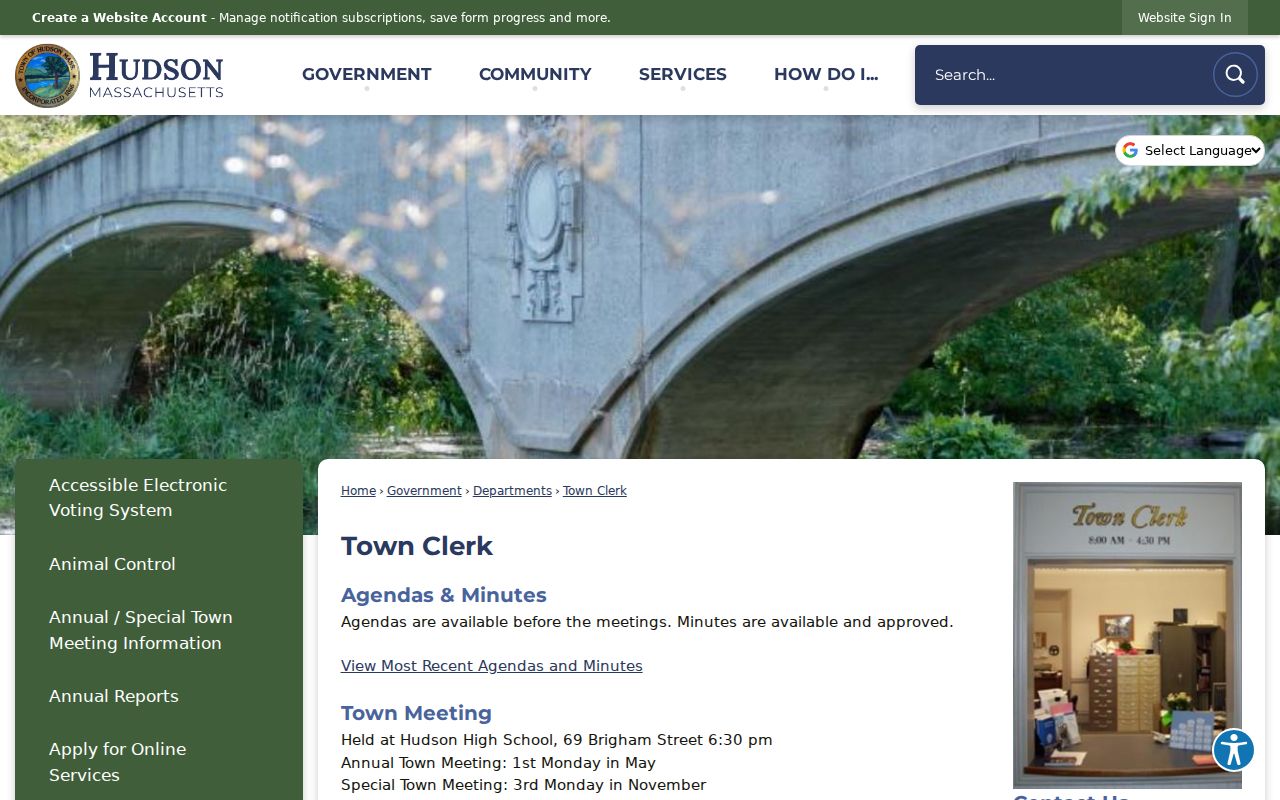
Ask one office for one defined record set. A town RAO does not hold a registry deed, a court docket, or a state vital record.
Hudson Court Records and Vital Checks
Massachusetts Trial Court eServices is a public docket-search entry point, and its warning is important: displayed information is not the official court record. Marlborough District Court serves Hudson, but court department, division, and location should be selected for the case rather than inferred from a town address. A docket hit requires a party-role, status, location, and disposition check.
Vital records have a separate path. Hudson Town Clerk is the local starting point, while the Massachusetts Registry of Vital Records and Statistics holds records from 1936 forward. The State Archives receives 1931 through 1935 material. Certified-copy eligibility varies with record type and relationship, and genealogy access is not the same as a certified-copy right.
The court eServices entry shows the official access notice.
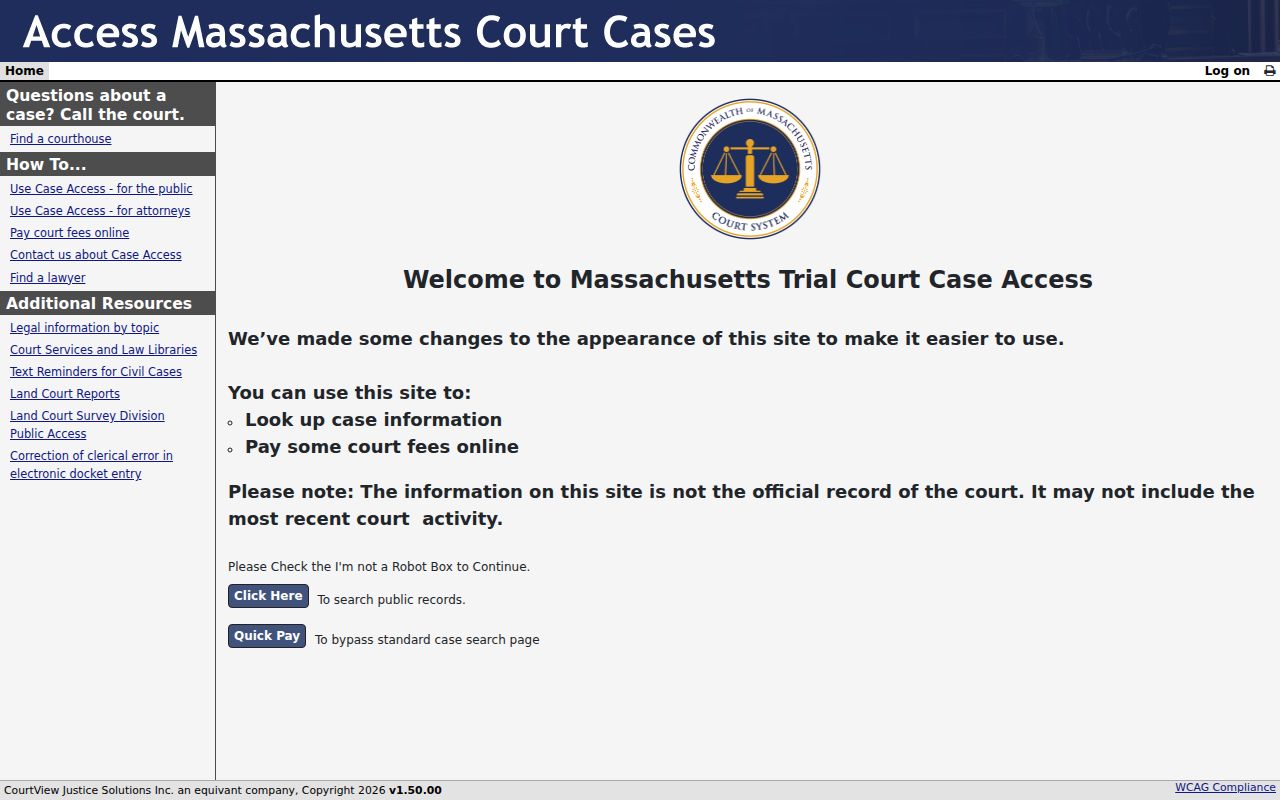
A court portal result is a lead to verify with the relevant clerk or official record.
Hudson Vital Record Access Rules
Massachusetts offers online, phone, mail, and in-person certificate routes. The research records different fees and timing by channel, but those details can change and must be checked at the current ordering page. Birth-to-unwed-parent, pre-adoption birth, certain marriage, and death-record fields can have special access limits. The state’s current rule text controls sensitive death-record Social Security number access on or after July 1, 2026.
For a genealogy question, identify the event town and date first. Pre-1936 records can require a city or town check, and the 1931 through 1935 archive handoff makes repository awareness especially important. Do not send a general public-record request expecting it to override vital-record restrictions.
The official certificate guidance separates the available ordering channels.
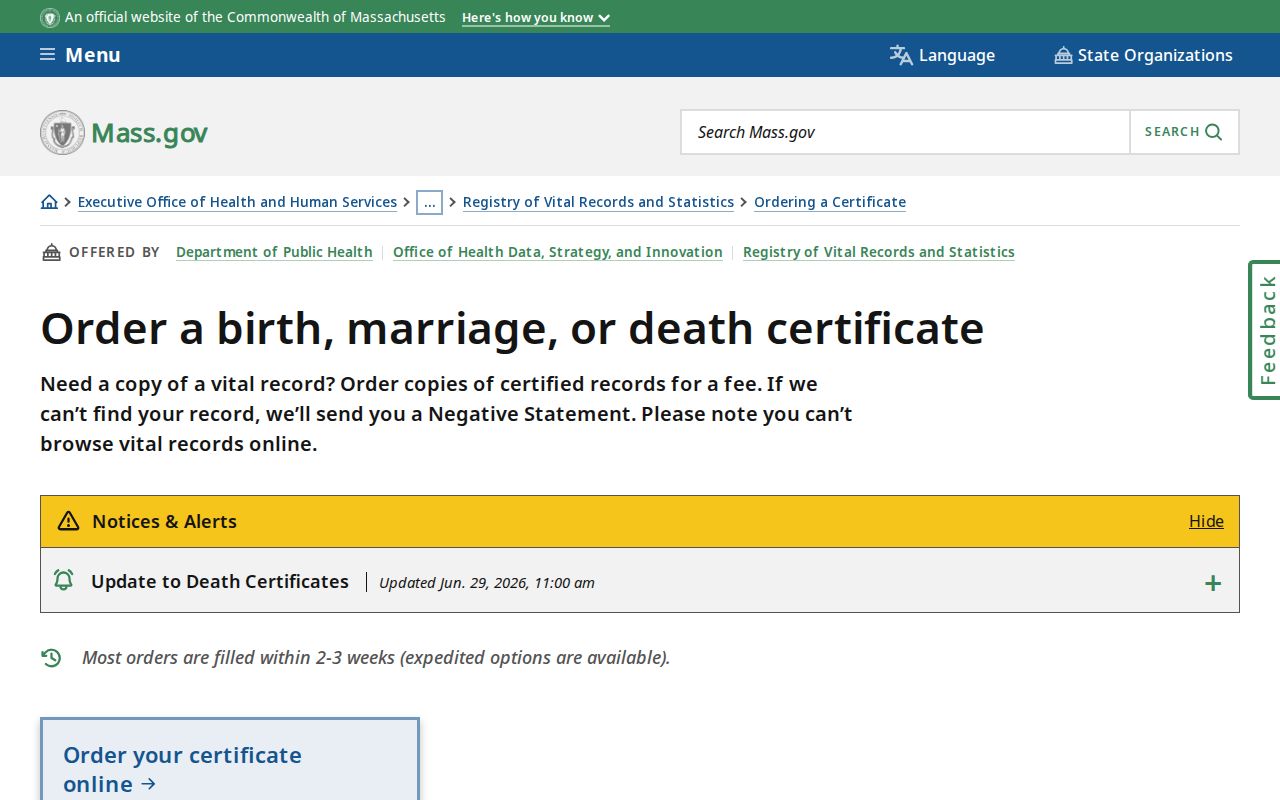
Use the custodian’s current eligibility and ordering rules before supplying sensitive details or payment.
Hudson Records and Unverified Listings
Official records can be incomplete, delayed, or limited by law. That is still different from a service that combines scattered data without showing the original custodian or date. For a Hudson name or address, the most useful trail identifies who created the record, when it was made, and what it actually records. Keep the source link and access date with a result.
| Source path | What the user can check | Practical limit |
|---|---|---|
| Official Hudson or Massachusetts record | Custodian, source type, access rule, and often a dated original record | May be restricted, incomplete, or require a targeted request |
| Library or archive collection | Collection scope, year, repository, and original publication context | Coverage can have gaps and may require in-person research |
| Unverified compiled listing | Very little unless it identifies its original source and date | Names and addresses can be stale, mixed, or wrongly matched |
Use the official or archival source for family history, civic questions, or a property trail. Confirm a sensitive or consequential fact with the custodian instead of repeating a compiled listing.
Historical Hudson Resident Directories
Hudson Public Library lists Town Reports from 1867 forward, Persons Listed Street Directories from 1914 forward, local-history holdings, and local newspaper microfilm. The Historical Society holds periodic Persons Listed reports and other local material, but its museum is temporarily closed while it seeks space. Contact the collection before visiting or asking for a lookup.
Those records support a dated historical association, not a continuous residence claim. A directory year, a report, an obituary, a yearbook, and a deed may all contribute different evidence. The Hudson city directories collection details the available years and how to read them.
Hudson Map Records and Archives
Historic records have a local built-environment context. Official town history describes the 1894 fire that destroyed much of downtown and the later rebuilt landscape in the Silas Felton Historic District. The Library of Congress holds a six-sheet November 1897 Hudson Sanborn set. Those maps can show building footprints, uses, materials, streets, hydrants, and fire-protection features, but not occupants.
The State Archives’ Hudson folder adds building-record index cards, including examples tied to Apsley Rubber Company and Main Street properties. These cards are finding aids, not complete property files. Pair an archival map or card with a directory, deed, town report, or newspaper citation before describing an address history.
Note: A historic map establishes building context, while a dated directory or record is needed to support a name association.
Hudson Privacy and Record Safety
Hudson resident records have privacy limits built in. Massachusetts confidential-voter protections omit protected names and addresses from public voter information. The Address Confidentiality Program can provide a substitute legal address and suppress a qualified participant’s actual address. Vital, court, school, RMV, police, and fire records can carry their own restrictions, redactions, or exemption rules.
Use official domains and agency phone numbers when a record request asks for payment or sensitive details. Massachusetts alerts have warned about jury-payment impersonation and RMV or registry text scams. A Registry Consumer Notification Service can alert a subscriber when an instrument is recorded in a name, but it does not prevent recording or establish title.
Lawful use. Hudson records are useful for personal, civic, and family-history research. Do not use any result to stalk, harass, intimidate, or harm another person.
Hudson ZIP Records and Town Boundaries
Most official Hudson addresses reviewed use ZIP 01749, but a ZIP is postal geography rather than a legal town boundary. The Hudson Post Office serves that ZIP, and USPS is the right source for current delivery questions. The town GIS and assessor maps are the right sources for a parcel’s local geography. A Middlesex South instrument is the right source for a recorded land question.
These distinctions matter at places whose local identity crosses a municipal line. Lake Boon spans Hudson and Stow. Fort Meadow has Hudson and Marlborough connections, while the Assabet River National Wildlife Refuge is only partly in Hudson. A Hudson mailing reference should trigger a parcel or boundary check instead of becoming a conclusion about residence, ownership, or town jurisdiction.
Use the ZIP as a search aid, then preserve the source’s own address spelling and date in your research notes.
Hudson Community Records, Not Rosters
Hudson’s official Community page is useful for locating civic organizations such as the Assabet Valley Chamber of Commerce, Hudson Business Association, Hudson Historical Society, Hudson Land Trust, Hudson Rotary Club, and League of Women Voters. Those links identify organizations and their public contact routes. They are not a public membership directory, and a group name should not be used to infer who lives on a street or belongs to a household.
Use a community source for its stated purpose. A historical society can identify local collections. A civic group can publish a meeting or contact. A town map can locate a public geography. If the question is who held a parcel, use the assessor or registry route. If the question is a historical household, use a dated directory, report, or newspaper source. Keeping those functions separate makes Hudson research more accurate and more respectful of privacy. It also leaves a clear path for correcting a mistaken source match through later review.