
Hudson Sources for Previous Residents
Hudson address history spans separate custodians. Middlesex South keeps recorded land instruments in Cambridge. Hudson Public Library and the Hudson Historical Society keep directories, reports, newspapers, and related local-history material. The Town’s GIS and assessment routes can help identify a current parcel and map-lot, but they do not prove title or occupancy. Start with the source that fits the time period, then compare sources whose purposes differ. That is the clearest way to separate past owners from previous residents.
| Source | Years It Covers | Where Held | What It Shows |
|---|---|---|---|
| Middlesex South recorded-land index | Online Hudson start year not located | Middlesex South Registry of Deeds | Recorded parties, dates, document references, and images when available |
| Persons Listed Street Directories | 1914-present | Hudson Public Library | Dated local directory evidence; inspect the volume for its fields |
| Persons Listed reports | 1920-1974; selected years through 2008 | Hudson Historical Society | Adults by name, address, and precinct |
| Town reports and Hudson newspapers | Town reports 1867-present; newspaper runs vary | Library and Historical Society | Period context, notices, and reported events |
| Building permit and property file | Date range varies by property record | Hudson Building Department and OpenGov | Permit, inspection, certificate, and paper-file leads |
A missing source is not an absence finding. The Historical Society’s Persons Listed sequence omits 1975, later report years are periodic, and the online start of the Registry’s Hudson index was not identified in the inspected materials. Write down the gap, then use another dated source rather than merging adjacent years into a continuous residence claim.
Hudson Previous Residents Deed Search
Hudson belongs to the Middlesex South Registry district, not to a local Hudson recorder. The Registry is at 208 Cambridge Street, Cambridge, MA 02141, with a listed phone number of 617-679-6300. Recording hours are Monday through Friday, 8:00 AM to 3:45 PM. Its public portal offers Recorded Land searches by Name, Document, Book, Property, Recorded Date, and Unindexed Property Search for Book 1-1024. The party form includes business or last name, first and middle name, party type, a second party row, document types, towns, and a recorded-date range.
The Middlesex South Registry search landing is the official entry for selecting a record group and search mode. At the time of research, public searching, viewing, printing, and downloading were stated as free. That access condition can change, so verify it before relying on it for a project or a visit.
Use Property when the goal is a street address, and use a party search when a deed supplies a former owner’s name. A result proves that a person or entity appeared in a recorded instrument. It does not, by itself, prove that the party lived at the Hudson address.
Trace Hudson Past Owners by Deed
A deed chain works backward from the current recorded transaction, not from a guess about a resident. First identify the parcel’s current street address and map-lot through Hudson’s GIS or assessment route. Then use the recorded instrument to find the prior transfer. The recorded image can include party names, a recording date, document number or book/page, consideration when present, a legal description, and signatures or acknowledgment. Related instruments, including mortgages, discharges, easements, restrictions, plans, and condominium documents, can add important title context.
- Use Hudson GIS or assessment information to record the exact street address and map-lot. Treat that information as a parcel locator, not as a title decision.
- Search the current owner or property in the Middlesex South Recorded Land index. Save the document type, recorded date, document number or book/page, town, and image link if displayed.
- Open the purchase deed and identify the seller. Search that seller as a grantee to find the earlier acquisition, then compare the legal description and date before treating it as the same parcel.
- Repeat the process backward, logging each instrument and any change in street address, lot configuration, trust name, or business party.
- When the online search does not reach the needed record, ask Registry staff about paper books, microfilm, unindexed material, and available copy or inspection options. The online start year for Hudson was not located.
- Grantor / grantee
- The grantor transfers an interest in the instrument; the grantee receives it. A party role must be read from the particular document rather than guessed from a name.
- Chain of title
- A dated sequence of recorded instruments used to trace interests in a parcel. It is not the same thing as a list of everyone who lived there.
- Legal description
- The property description in a deed or related instrument. It can tie an older record to the same parcel when a street address changes or lots are split or combined.
Hudson Past Residents Parcel Clues
Hudson’s official GIS viewer supports searches by Parcel ID, Street Address, and Owner. A selected parcel can open information and link to assessment data. That makes GIS a useful first stop for spelling, map-lot, parcel location, and present-day address context. The separate VGSI assessment database is the town-linked assessment route. Neither source substitutes for a deed or proves that a person lived at the property during a historical period.
When a name is common, compare the town, street address, document type, recording date, party role, and legal description. A record can list a trust, business, or other entity instead of an individual. Likewise, a changing house number or changed parcel boundary can make a simple address search misleading. Save the map-lot with each note, then use the Registry image to test the land-record connection.
Note: Assessment ownership, recorded ownership, and occupancy are different evidence categories.
Hudson Past Residents by Household
Deeds trace the property side of a Hudson address. Directories, Persons Listed reports, town reports, and newspapers help answer who lived here before. Hudson Public Library lists Persons Listed Street Directories from 1914 to the present, local town reports from 1867 to the present, assessors volumes for 1956, 1961, and 1974, and microfilm for the Hudson Sun and Hudson News Enterprise. The Historical Society’s Persons Listed reports add adult names, addresses, and precincts for its stated years.
Hudson Public Library’s local-history resource is the starting point for these holdings, library-only Ancestry.com and NewEnglandAncestors.org access, and listed digital newspaper routes. The Hudson city directories collection details the holdings and access cautions.
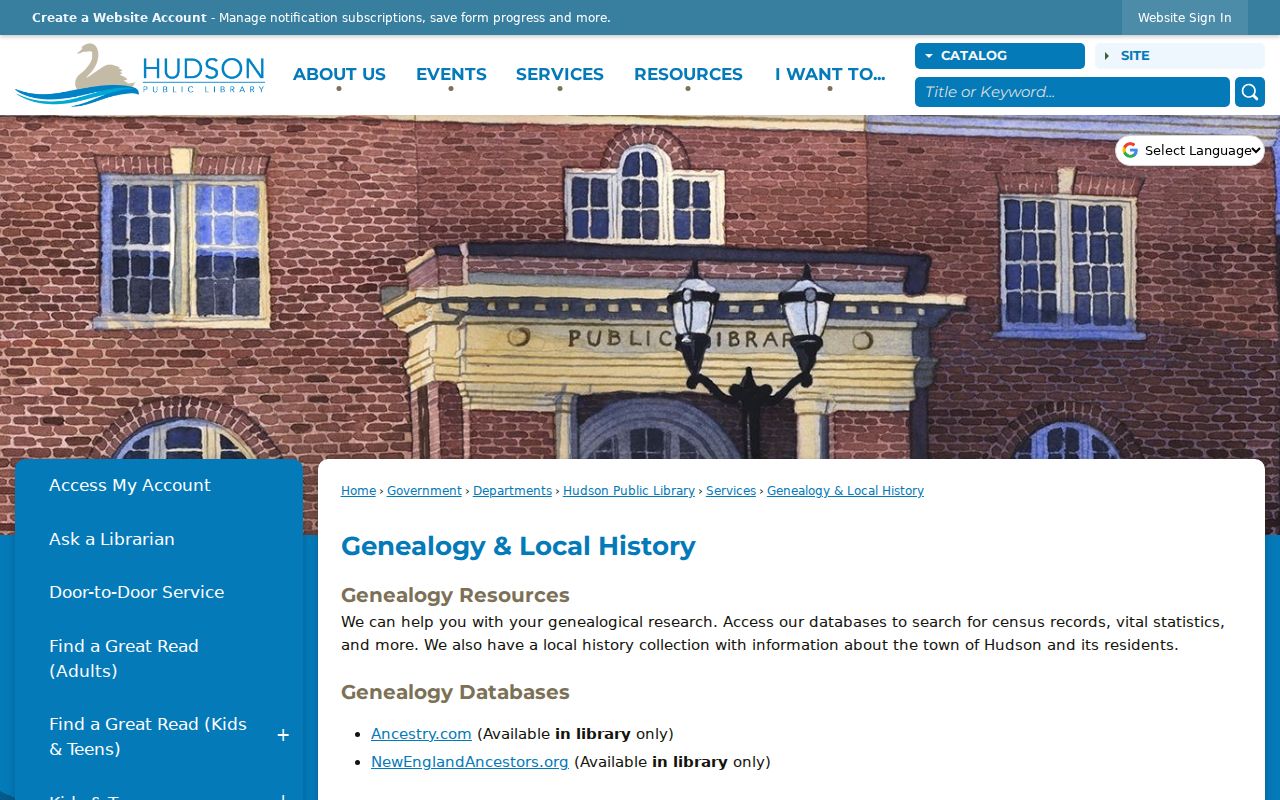
A directory source may show a person near a date, while a census or another period record can test the household composition. The library listing does not promise that every Hudson item is digitized.
- Set a date range from a deed, directory, town report, newspaper notice, yearbook, marriage intention, or voter record. Keep the source and date together.
- Find the surname, household, or address in the nearest Persons Listed report or street directory. Record the printed name, address, precinct when present, volume date, and page.
- Check the closest available earlier and later directory years. Mark every missing edition or unlisted period rather than silently filling it.
- Pair the dated directory results with the matching federal census period or another independently dated household source. The purpose is to test names and timing, not to assume that a shared address proves identity.
- Use Hudson newspaper material, cemetery information, vital-record pathways, or a deed to investigate whether a disappearance reflects a move, death, changed name, or a coverage gap.
Hudson Previous Residents Gaps
The Historical Society’s Persons Listed holdings run from 1920 through 1974, then skip to 1976-1978 and selected later years through 2008. Each report records adults age 18 and over with name, address, and precinct. That scope makes it valuable for an address chronology, but it also sets clear limits: a child will not be covered by the society’s stated description, and no report in the listed sequence means a 1975 address cannot be resolved from that source alone.
The Historical Society’s museum is temporarily closed and invites email inquiries at hudsonhistorical1916@gmail.com. Its closure notice takes priority over an older municipal visiting listing. If a box or report cannot be inspected, cite the unavailable source and turn to the library’s directories, town reports, newspapers, or registry instruments. A negative search always needs the collection, years, name form, and access condition attached to it.
Hudson Past Residents 1897 Context
The Library of Congress holds a six-sheet November 1897 Sanborn Fire Insurance Map of Hudson. The set can show a building’s footprint, size, use, materials, streets, property boundaries, house or block numbers, hydrants, water, and fire alarms. It is especially helpful when a historic directory or deed points to an address near the period of the 1894 downtown fire and subsequent rebuilding.
Use the map after identifying a street and date in another source. Compare the building context with town reports, newspapers, State Archives building-card metadata, or historic-district and GIS layers. The map does not identify occupants, prove residence, or establish a later building date. Hudson-specific research confirmed this 1897 six-sheet set only, so later Hudson sheets should not be assumed.
Hudson Past Residents Permit Status
Hudson’s Building Department routes permits through OpenGov. Historical paper permits were migrated and given IDs in the form HIST-XX-XXX, with a complete status. That status is a useful pointer to a historical paper record, but it does not prove a final inspection, a signed closure, or a certificate. An addition or other work item should not be treated as complete solely because the migrated permit record says complete.
Insider tip. For a HIST-XX-XXX permit, request the property file and inspect the paper permit for an inspector signature. Compare the permit, inspection record, final inspection, certificate, zoning record, and assessor improvement data before drawing a conclusion.
The Building Department lists 978-568-9625 for inspection logistics. A narrow request can name the address, permit ID if known, and date range, then ask for permits, inspection reports, certificates, zoning approvals, and related correspondence. The research did not capture all live OpenGov fields, so do not infer an application field or result column that is not visible.
Hudson Previous Residents Research Access
Registry images can be searched and viewed online through the public Middlesex South portal at the access level stated during research. Historical directories, reports, microfilm, and specialized context usually require library, Historical Society, State Library, or archive research. An online deed image is not a complete household history.
| Registry portal | Recorded land searching and document viewing/download were stated as free at research time; verify current access and coverage. |
|---|---|
| Library and Historical Society | Hold local directories, reports, newspapers, and yearbooks; access depends on collection, current hours, and the society’s closure status. |
| State Archives and Library of Congress | Supply supporting building and map context, not a continuous list of previous residents. |
A deed supports a recorded transaction, a directory or report supplies a dated local listing, and a map describes building context. Their overlap can strengthen an address history, but none tells the whole story.
Use Hudson Previous Resident Records Lawfully
Previous-resident research is appropriate for family history, house history, estate questions, civic research, and personal curiosity. Treat details about living people with care, and do not use address records to stalk, harass, or harm anyone. When information is sensitive, old, or unclear, confirm it with the office that holds the original record instead of trying to build a profile from scattered listings.
Lawful use. Keep a personal research log of sources and dates. Share only what is necessary for a lawful purpose, and avoid publishing or using a historical address trail in a way that puts a living person at risk.