
Hudson Neighbors Around One Block
Different public sources answer different block questions. The town’s GIS can locate a parcel and return nearby parcel or abutter results. Election resources describe precinct geography and support an individual status check, subject to privacy rules. Library sources can establish a historical address trail. None of those sources is a household census. The table separates their documented uses so that a result is not given more weight than it can bear.
| Source | What It Shows About a Block | Access |
|---|---|---|
| Town of Hudson GIS Online Property Viewer | Parcel location, selected parcel information, and returned abutter parcels. | Public online viewer with documented search and map tools. |
| Hudson assessment database | Town-linked assessment route for property context; exact live card fields were not captured. | Online database; use with the GIS rather than as proof of title. |
| Hudson Elections and state lookup | Precinct resources and individual registration-status information, within statutory privacy limits. | Town and state resources; a local list request follows the lawful request route. |
| Library local-history materials | Earlier street, persons-listed, town-report, and newspaper references for a period-specific block trail. | Hudson Public Library collections and local-history access. |
An owner name attached to a parcel is not a finding about everyone at that address. Likewise, an abutter export is a set of parcels returned by a town tool, not a count of Hudson neighbors or a list of households. Keep the address, source, search distance, and date with any note made from the result.
Hudson GIS Tools for Neighbors
The Town of Hudson GIS Online Property Viewer is the official nearby-parcel route. Its help material documents Search, Layers, Legend, Abutters, Print, and About widgets. The search choices are Parcel ID, Street Address, and Owner. A selected result zooms to the parcel; clicking the parcel opens its parcel data, and the More Info route leads to assessment information. Those documented steps are more reliable than guessing from a map label.
The viewer also separates map layers that are easy to confuse. Assessor maps, precincts, historic districts, zoning, wetlands, watersheds, and other overlay maps represent distinct geographies. A parcel may fall within several layers, but that does not create an official neighborhood name or show a social connection between people on nearby parcels.
The Hudson Elections and Voting page is the source represented in this Hudson civic-reference image.
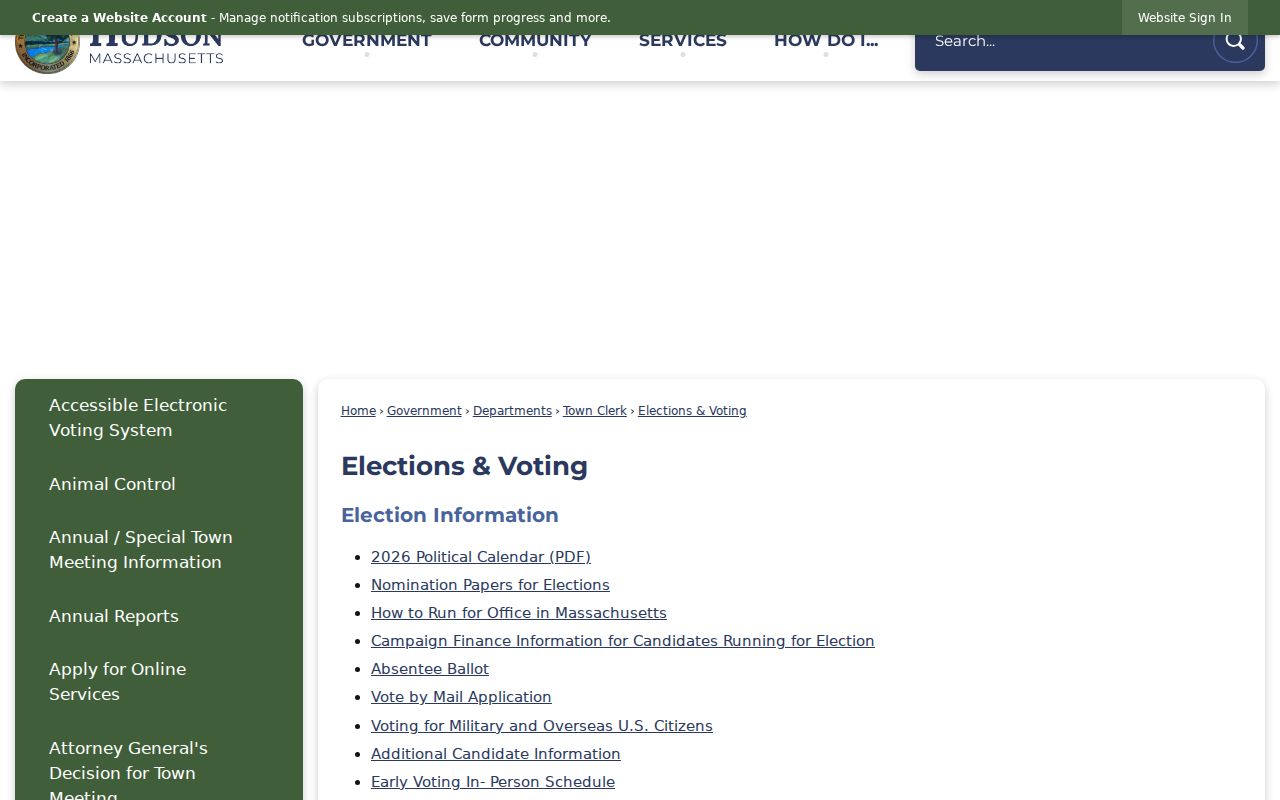
Its precinct, registration, ballot, early-voting, absentee, and results links support civic geography, but they do not replace parcel-based research for a particular block.
Map Hudson Neighbors by Parcel
The abutter sequence starts from a parcel, then expands by a stated distance. It is different from browsing a street as a whole. The town’s help guide names each required control, which makes the method repeatable without claiming fields or defaults the guide did not document.
- Use Street Address, Parcel ID, or Owner in the Hudson GIS Search tool. Select the result so the map zooms to the target parcel, then click it to open parcel data and use More Info for assessment context.
- Choose Actions, then Set Location, to open Abutters Search. Choose Set Location again to run the nearby-parcel search from the selected location.
- Use the selection tools to review returned parcels. Delete or refresh the result list when changing the selection, and reset the search distance before a new run.
- Export the returned abutters list to CSV when a saved parcel record is needed. Record the radius and the access date with the export, then describe it as parcels or abutters returned by GIS.
The official help does not state a universal default distance or every CSV output column. Those items remain unconfirmed, so a result should retain the radius actually chosen rather than assuming a default. For a full named-street record chain rather than a radius search, use the Hudson by-street directory.
Hudson Precincts and Block Records
Hudson has six voting precincts after the 2020 Census. A precinct is political geography, not a neighborhood boundary. The town’s precinct map and election material are appropriate for locating an election unit, while a parcel map is appropriate for locating land. Neither source should be used to label a block with an informal neighborhood name that official records do not support.
Massachusetts provides an individual voter lookup that takes a name, date of birth, and residential ZIP. Under MGL c.51 §64, its output can indicate registration or pre-registration status, active or inactive status, polling place, and representatives. It is a status tool, not a block roster or a historical address trail. Hudson-specific public voter information may be requested from the local election office in the lawful format and with the requested date clearly stated.
Confidential voters’ names and addresses are omitted from public lists and state database access. A no-match cannot prove that a person does not live in Hudson, particularly after a move or where protected status applies.
Hudson Civic Contacts Near a Block
The official Hudson Community page gives local civic leads. It lists organizations, not a neighborhood-association map, member directory, or current roster. These groups can offer public events, history, conservation, or civic context. A listing does not show that any group represents a particular block, and membership details should not be scraped or published.
| Civic group | Official contact route | Appropriate block context |
|---|---|---|
| Assabet Valley Chamber of Commerce | Town Community page | Public business and regional civic context. |
| Hudson Business Association | Town Community page | Public downtown and business-community context. |
| Hudson Historical Society | Town Community page | Historical place and archive leads. |
| Hudson Land Trust | Town Community page | Land and open-space context. |
| Hudson Rotary Club | Town Community page | Public civic activities and events. |
| League of Women Voters | Town Community page | Public civic and election-information context. |
No official current neighborhood-association map or member list was located in the reviewed sources. Contact an organization through its official route for its own public information, and do not infer who belongs from a parcel, a precinct, or a nearby address.
Hudson Neighbors: Record Types Compared
Official sources have defined custodians, dates, and limits. Commercially compiled neighbor categories can combine material from varied sources, but a combined listing does not show what is current, complete, or appropriate to repeat. The comparison below keeps the decision focused on source quality rather than on a named commercial service.
| Source category | Useful for | Limit to keep |
|---|---|---|
| Official parcel and abutter record | Parcel geography and returned nearby parcels. | Does not establish household composition, presence, or personal relationships. |
| Official election resource | Individual status and precinct information within applicable rules. | Protected voters and nonpublic fields are excluded; it is not a block directory. |
| Commercial compiled category | A lead that requires independent verification. | May blend dates and sources; do not treat it as a public-record custodian or republish its claims. |
A local public-record request has a clearer route when a town-held record is needed. Hudson’s request guidance allows in-person, mail, fax, and email channels and uses a ten-business-day response framework. Ask for the defined record, date range, and electronic format rather than requesting broad personal profiles.
Hudson Neighbors Across Water Lines
Some of Hudson’s strongest place connections cross town lines. Lake Boon lies on the Hudson-Stow border, and the Lake Boon Association dates to 1921. Fort Meadow Reservoir is largely in Marlborough, while Centennial Beach is in Hudson and the commission is joint. The Assabet River National Wildlife Refuge is partly in Hudson. These are useful community and landscape facts, not proof that a person is a neighbor or belongs to an association.
The town’s industrial history also follows the Assabet River and Tannery Brook, which helped shape downtown, mill, and worker or manager areas. The Master Plan supports that broad pattern but does not provide a current street-by-street roster. Use historic geography as context, then return to a dated parcel, directory, or map source for an address-specific claim.
Note: A lake, refuge, historic district, precinct, and parcel boundary each describe Hudson differently and should never be merged into one neighbor label.
Historical Hudson Blocks by Address
For a period-specific block trail, Hudson Public Library local-history materials are the better next step. The collection includes Persons Listed reports, which can provide an adult name, address, and precinct for the years available, along with street directories, town reports, newspapers, and microfilm. Historical research can also use the 1897 Sanborn map set, deeds, and town reports. Each source represents a particular date and purpose, so a name appearing in one volume should not be converted into a current claim.
Start with the selected parcel and street name, then compare the date of a directory or report with the historic map and recorded deed trail. Older sources may use a different address form, and a property record may document a party to an instrument rather than every person associated with the location. Hudson neighbors in a historical record are evidence for that period only.
Privacy Boundaries for Hudson Neighbors
Public access has real limits. Confidential voter names and addresses are omitted, and Massachusetts Address Confidentiality Program participants can use substitute or suppressed address treatment. Do not infer household composition, occupancy status, children, or a person’s presence from a parcel result, a voter result, an abutter CSV, or an organization link. USPS delivery and forwarding status are not public resident information.
When a record feels sensitive, reduce the question to the least amount of information needed and return to the custodian that holds it. Hudson’s RAO must apply exemptions and redact nonpublic material. Public availability does not remove the need for restraint.